<?xml version="1.0" encoding="utf-8"?><feed xmlns="http://www.w3.org/2005/Atom" ><generator uri="https://jekyllrb.com/" version="3.10.0">Jekyll</generator><link href="https://www.fakhirali.pk/blog/feed.xml" rel="self" type="application/atom+xml" /><link href="https://www.fakhirali.pk/blog/" rel="alternate" type="text/html" /><updated>2026-10-30T22:17:11+00:00</updated><id>https://www.fakhirali.pk/blog/feed.xml</id><title type="html">Thoughts</title><entry><title type="html">A Case Against Training Your Own LLMs</title><link href="https://www.fakhirali.pk/blog/2024/05/24/LLM.html" rel="alternate" type="text/html" title="A Case Against Training Your Own LLMs" /><published>2024-05-24T00:00:00+00:00</published><updated>2024-05-24T00:00:00+00:00</updated><id>https://www.fakhirali.pk/blog/2024/05/24/LLM</id><content type="html" xml:base="https://www.fakhirali.pk/blog/2024/05/24/LLM.html"><![CDATA[<p><em>(Unless You’re an AI Lab)</em></p>

<h2 id="the-reality-check">The Reality Check</h2>

<p>GPT-4 is estimated to have over 1 trillion parameters, while GPT-3.5 has 175 billion parameters and offers fine-tuning capabilities. This raises an important question: Can smaller, custom-trained models truly compete?</p>

<p>Consider this scenario:</p>
<ul>
  <li>You hire a team of 10 people</li>
  <li>Invest in expensive GPU infrastructure</li>
  <li>Navigate the complexities of CUDA and PyTorch</li>
  <li>Finally achieve a model that performs well on your specific task</li>
</ul>

<p>Then suddenly, a major AI lab releases a model that’s both 10x better and half the price. Meanwhile, someone using clever prompting achieves similar results to your custom model without any training costs.</p>

<h2 id="the-better-approach">The Better Approach</h2>

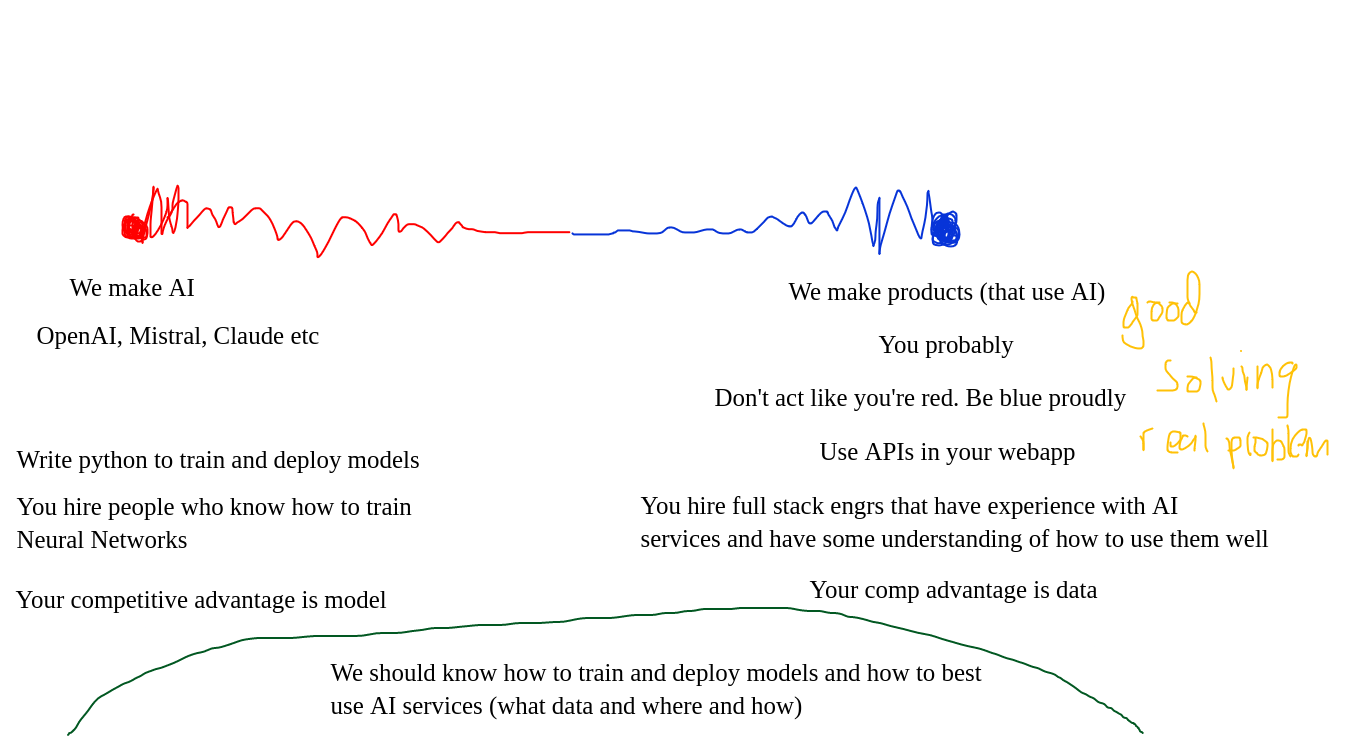
<p>Stop trying to compete with AI labs and start thinking long-term about your customers’ needs. Having the technical ability to train LLMs doesn’t mean it’s the right business decision.</p>

<h2 id="common-objections">Common Objections</h2>

<p><strong>Q: “It’s just a GPT wrapper.”</strong><br />
A: If your product’s barrier to entry is that low, that’s on you. Everyone has access to LLM providers, just like cloud providers - we don’t dismiss cloud-based services as “AWS wrappers.” Focus on your unique value proposition.</p>

<p><strong>Q: “We’re too dependent on OpenAI.”</strong><br />
A: You mean dependent on AWS or GCP? If you’re concerned, maintain backups (Gemini, Claude, Meta, etc.).</p>

<p><strong>Q: “Investors won’t fund us without custom models.”</strong><br />
A: Those investors likely don’t understand the space. Building custom models for the sake of fundraising is a short-sighted strategy.</p>

<p><strong>Q: “What value are you adding if you’re just using an API?”</strong><br />
A: We’re delivering the best possible solution to our customers. Success isn’t about technical complexity - it’s about serving people’s needs effectively and efficiently.</p>

<p><img src="/myblog/assets/modes_of_AI_industry.png" alt="image" /></p>]]></content><author><name></name></author><summary type="html"><![CDATA[(Unless You’re an AI Lab)]]></summary></entry><entry><title type="html">200 Commits Later: Key Lessons Learned</title><link href="https://www.fakhirali.pk/blog/2024/05/06/OVC.html" rel="alternate" type="text/html" title="200 Commits Later: Key Lessons Learned" /><published>2024-05-06T00:00:00+00:00</published><updated>2024-05-06T00:00:00+00:00</updated><id>https://www.fakhirali.pk/blog/2024/05/06/OVC</id><content type="html" xml:base="https://www.fakhirali.pk/blog/2024/05/06/OVC.html"><![CDATA[<p>I have written over 200 commits on <a href="http://www.fakhirali.pk/OpenVoiceChat/">OpenVoiceChat</a>.
Here are the key lessons I’ve learned along the way.</p>

<h3 id="process-level-instead-of-object-level">Process Level Instead of Object Level</h3>

<p>I found it helpful to separate objects from the processes they undergo.
Abstracting object-specific code makes the system highly flexible and easier to modify. 
OpenVoiceChat is built with this principle in mind - all object-level code is abstracted out. 
This makes <a href="https://www.finityalpha.com/OpenVoiceChat/Adding_models/">supporting new models very straightforward</a>,
allowing OpenVoiceChat to improve naturally as models advance.</p>

<h3 id="managing-complexity">Managing Complexity</h3>
<p>The key is finding the right balance - don’t hide complexity completely, but don’t expose it unnecessarily.
Each view of the code should be easy to understand and navigate. However, too many different views
can become confusing. This mainly involves creating well-structured functions and
semantically separating code.</p>

<details><summary>More Output/Features with Less Complexity</summary>
If we can improve performance through a more complex approach, it's
net neutral. Improving while maintaining the same level of
complexity is net positive. The goal should be writing more general, simpler code.

Moving to an end-to-end learned-search approach should always be the goal.
For example, replacing VAD-silence detection with a model-based approach. Gradually, each process would be learned 
end-to-end. Everything would follow the principle of <a href="http://www.incompleteideas.net/IncIdeas/BitterLesson.html">search and learning</a>.
</details>

<h3 id="the-value-of-refactoring">The Value of Refactoring</h3>

<p>While refactoring doesn’t directly add features or fix bugs,
it’s crucial for long-term maintainability. It makes both feature additions and bug fixes 
easier in the future. I always feel better after I’ve <a href="https://github.com/fakhirali/OpenVoiceChat/pull/7#issuecomment-2002091687">cleaned up</a>
the codebase.</p>

<h3 id="areas-for-improvement">Areas for Improvement</h3>

<ol>
  <li>
    <p><strong>Code Navigation</strong>: There’s more indirection than would be ideal. Understanding the system
requires jumping between different parts of the code more frequently than I’d prefer.</p>
  </li>
  <li>
    <p><strong>Planning</strong>: Some components needed rewrites that could have been avoided
with better initial planning.</p>
  </li>
  <li>
    <p><strong>Testing</strong>: This remains an open challenge - how can we effectively test these systems?</p>
  </li>
</ol>]]></content><author><name></name></author><summary type="html"><![CDATA[I have written over 200 commits on OpenVoiceChat. Here are the key lessons I’ve learned along the way.]]></summary></entry><entry><title type="html">Why Open Source?</title><link href="https://www.fakhirali.pk/blog/2024/03/31/OpenSource.html" rel="alternate" type="text/html" title="Why Open Source?" /><published>2024-03-31T00:00:00+00:00</published><updated>2024-03-31T00:00:00+00:00</updated><id>https://www.fakhirali.pk/blog/2024/03/31/OpenSource</id><content type="html" xml:base="https://www.fakhirali.pk/blog/2024/03/31/OpenSource.html"><![CDATA[<p>I am building an open source <a href="https://github.com/fakhirali/OpenVoiceChat">library</a> that can be used to build voice assistants. The feedback I’ve received suggests I should build a product company instead. Here are several reasons why I’m choosing to build an open source library instead.</p>

<h2 id="strong-competition">Strong Competition</h2>
<p>I would face significant <a href="https://github.com/fakhirali/OpenVoiceChat/blob/master/notes/Competition.md">competition</a> in the product space. Established competitors would likely crush a new entrant - they have more capital, better talent, and immediate market access. The chances of success would be very low.</p>

<h2 id="better-founder-market-fit">Better Founder-Market Fit</h2>
<p>As a founder of a traditional company, one has to handle multiple responsibilities including marketing, sales, hiring, and operations. I am primarily a developer who loves building things. With an open source project, I have excellent founder-market fit since my users are developers like myself.</p>

<h2 id="market-opportunity">Market Opportunity</h2>
<p>There is currently no comprehensive open source alternative in this space - a clear gap in the market. I’m well-suited to fill this gap as a developer who understands the needs of other developers. Since the project is open source and free, the barrier to user adoption is much lower.</p>

<h2 id="career-benefits">Career Benefits</h2>
<p>An open source project with active users can be more valuable for career growth than a failed startup attempt on a resume.</p>

<h2 id="advice-for-other-builders">Advice for Other Builders</h2>
<p>I encourage other builders to consider this strategy instead of immediately jumping into building a product company:</p>
<ul>
  <li>User acquisition is typically easier with open source</li>
  <li>Funding becomes more accessible once you have an active user base</li>
  <li>User feedback helps refine the product into something people actually want</li>
  <li>The success criteria are more flexible</li>
  <li>Worst case: it’s a learning experience</li>
  <li>Best case: it becomes a multi-million/billion-dollar company</li>
</ul>

<p>(Note: This isn’t to discourage building product companies - they can offer potentially higher rewards for those willing to take the risk.)</p>

<h2 id="faqs">FAQs</h2>

<p>Q: Doesn’t open source mean you can’t make money?
A: This is a misconception. Companies like Docker, Blender, and RASA have proven successful business models through enterprise versions and optimized hosted services.</p>]]></content><author><name></name></author><summary type="html"><![CDATA[I am building an open source library that can be used to build voice assistants. The feedback I’ve received suggests I should build a product company instead. Here are several reasons why I’m choosing to build an open source library instead.]]></summary></entry><entry><title type="html">Why I dropped out of University</title><link href="https://www.fakhirali.pk/blog/2024/03/15/Dropout.html" rel="alternate" type="text/html" title="Why I dropped out of University" /><published>2024-03-15T00:00:00+00:00</published><updated>2024-03-15T00:00:00+00:00</updated><id>https://www.fakhirali.pk/blog/2024/03/15/Dropout</id><content type="html" xml:base="https://www.fakhirali.pk/blog/2024/03/15/Dropout.html"><![CDATA[<p>The Internet is all you need. Most of the stuff I’ve learned to <a href="https://github.com/fakhirali">do</a> is from the internet.
If you really want to learn things, then sitting in classes is very very inefficient. 
Learning at your own pace, in your own way while working on your own projects is much better.
Nobody really argues this.
The main argument I get from people is that <strong>having a degree is important</strong>.</p>

<h2 id="to-what-degree">To what Degree?</h2>

<p>When I am encouraged to return to education, the emphasis is rarely on
the importance of becoming more educated.
Instead, everyone just wants me to get a degree.
These, very wise, individuals want me to attend an educational institution where teachers and 
professors conduct classes, deliver lectures, administer exams, and assign homework, 
all for a piece of paper that says I was there.
These people see no inherent value in going to a university. They only value the “doors” that a degree can open.
According to their wisdom, I’ll also be working a job for money, doing volunteer work for a resume,
talking to people for potential career advancements, buying things for social status, etc.
I personally do things for the inherent benefit of doing them.
I guess it is not in me to <a href="https://www.google.com/search?q=faustian+bargain">go to an educational institution
for something other than education</a>.</p>

<p>If degree is the thing that holds all the importance/value, then why not just buy one?
What’s the difference?</p>

<h2 id="going-to-university-has-some-benefits">Going to University has some benefits</h2>

<p>I am not encouraging anyone to drop out of university.
In fact, there are several advantages to attending university that are worth considering.
If a person does not know what to do with their life, then university is a good place to figure that out
(a bit late though).
University also provides an enforcing force for studying, assignments,
etc. (forcing doesn’t help though).
It’s a good place to meet people and make friends.
You also get access to a lot of resources and opportunities that you would not have had otherwise (maybe).
You also get to interact with people who are experts in their field. 
You can get these things elsewhere, but university sure makes it easier.
Everything else (classes, exams, assignments) is just meh. You are much better off curating 
an educational experience for yourself.</p>

<h2 id="understanding-credentials">Understanding Credentials</h2>

<p>If you met someone, and they told you that they were good at programming, would you believe them?
What would it take for you to believe them? A degree was made to solve this problem.
It is a way to prove that you are good at something. When someone shows you 
a certificate, you believe their competency. A degree is nothing more and nothing less.
It is not a requirement. One can prove their competency in many other ways like 
experience, projects, references, etc. Signaling competence is important when you want to get a job.
A degree signals some level of competency; if you have other ways to signal that, then you don’t really
need a degree.</p>

<p>I would argue that a university degree is not the best way to signal competence. Almost everyone has one.
University rankings are there to differentiate between people who have degrees from different universities.
GPA is for differentiating between people who have a degree from the same university.
All of these things add noise and make things so messy that in the end, they take interviews and offer internships
to figure out who is good and who is not. Compare that to a person who made a product/project 
that utilizes xyz technology. How hard would it be to figure out if they are good or not?
So in the end, what matters is how good you are; all of these things
are just proxies made by people like you and me.</p>

<h2 id="faqs">FAQs</h2>

<p>Q: You’ve done 3 years, why not just get over with it?</p>

<p>A: University hasn’t taught you <a href="https://www.google.com/search?q=sunk+cost+fallacy">this</a>. If the last 3 years would go to waste, then
so will the next year. Oh no, but once you get a degree, all those years will be worth it.</p>

<p>Q: You think you are the next Mark Zuckerberg?</p>

<p>A: Definitely not, but check out <a href="https://vector-ai.co/products/vfit/">what</a> I made within 6 months of dropping out.</p>

<p>Q: Would you ever go back to university?</p>

<p>A: If someone told me that going there would increase my knowledge, improve my capabilities, 
make me a better person, then yes.</p>

<p>Q: You won’t be able to do X because you won’t have a degree.</p>

<p>A: No problem. I’ll just buy one. lol. (I am willing to sacrifice some things for this decision as
I think it is correct)</p>

<p>Q: I think you are wrong, how do I tell you?</p>

<p>A: Email me at fakhir.ali@finityalpha.com</p>]]></content><author><name></name></author><summary type="html"><![CDATA[The Internet is all you need. Most of the stuff I’ve learned to do is from the internet. If you really want to learn things, then sitting in classes is very very inefficient. Learning at your own pace, in your own way while working on your own projects is much better. Nobody really argues this. The main argument I get from people is that having a degree is important.]]></summary></entry><entry><title type="html">Designed Disease</title><link href="https://www.fakhirali.pk/blog/2022/11/08/Disease.html" rel="alternate" type="text/html" title="Designed Disease" /><published>2022-11-08T00:00:00+00:00</published><updated>2022-11-08T00:00:00+00:00</updated><id>https://www.fakhirali.pk/blog/2022/11/08/Disease</id><content type="html" xml:base="https://www.fakhirali.pk/blog/2022/11/08/Disease.html"><![CDATA[<p>A group of highly intelligent scientists set out to create the perfect disease.
They formulated many designs, iterated over many drafts and after months of hard honest work finally figured it out.</p>

<p>The scientists designed a consumable form of the disease, a poison perhaps.
The poison is designed such that it is extremely delicious, so much so that people would recommend it to their peers.
This way the disease becomes contagious and very addictive.
The person is infected as soon as the poison is consumed, however the symptoms of the disease are not evident immediately.
When the symptoms do occur there is no way to trace them back to the poison.
The symptoms cause no pain. They simply chip away at the person’s ability to function, slowly, until they can no longer do so reliably. And because there is no pain, they never suspect a thing.
The disease’s affect on a person increases as more people around the person are infected.
When enough people are infected noone is suspicious of any minor symptoms encountered.
Infact if they find a person not infected, it would seem <em>odd</em> to them the fact that they are free of any symptoms everyone else has.</p>

<p>The team was very proud of their design.
It didn’t matter what the symptoms were, any disease packaged in this manner was destined to be successful.</p>

<p>If such a disease exists I hope I am the person that people find <em>odd</em>.</p>]]></content><author><name></name></author><summary type="html"><![CDATA[A group of highly intelligent scientists set out to create the perfect disease. They formulated many designs, iterated over many drafts and after months of hard honest work finally figured it out.]]></summary></entry></feed>